AI Search Is Rewriting SEO: A Practical Guide to Answer Engine Optimization
Search doesn't end in ten blue links anymore
Type a question into ChatGPT, Gemini, or Perplexity today and you get one answer — not a page of results to sift through. No scrolling, no clicking, no comparing five tabs. If your brand isn't part of that single answer, you don't just rank lower. You don't exist.
This is the shift traditional SEO wasn't built for. You can hold the #1 spot on Google and still be completely invisible inside an AI-generated recommendation, because AI answer engines don't read the web the way search crawlers do — they synthesize, cite selectively, and often skip your site entirely in favor of the two or three sources they trust most.
What "Answer Engine Optimization" actually means
Answer Engine Optimization (AEO) is the practice of making sure AI assistants can confidently understand, trust, and cite your brand when someone asks a question your product answers. It sits next to traditional SEO rather than replacing it, but the levers are different:
- Traditional SEO optimizes for crawlers, backlinks, and keyword density to win a ranked list of links.
- AEO optimizes for language models that read your content once, extract a claim, and decide whether to repeat it — with your name attached, or without it.
How AI engines decide who gets cited
Every major model — ChatGPT, Gemini, Claude, Perplexity — leans on a similar set of signals when choosing what to mention:
- Structured, unambiguous data. Clear pricing, feature lists, and comparison tables get extracted more reliably than marketing prose.
- Trust signals (E-E-A-T). Experience, expertise, authoritativeness, and trust — verified case studies, real author bios, and consistent claims across your site — make a model more confident repeating what you say.
- Freshness. Outdated docs and stale changelogs get skipped in favor of competitors publishing current information.
- Explicit crawler guidance. An
llms.txtfile tells AI crawlers what to prioritize on your site, the same wayrobots.txtguides traditional search bots.
The metrics that actually matter now
Rank position alone doesn't tell you whether AI mentions you. The metrics worth tracking are:
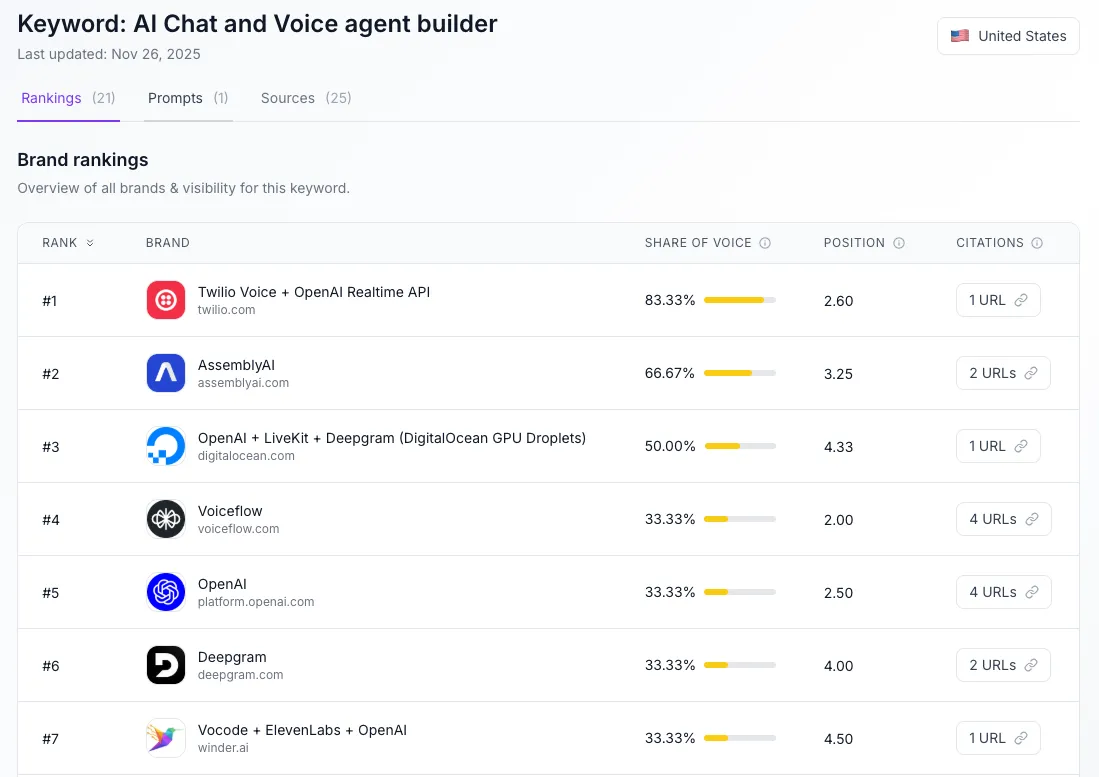
- Share of Voice — the percentage of AI responses for a given keyword that mention your brand at all.
- Brand mention rank — where you land among the brands an AI engine does choose to name.
- Citation frequency by engine — because ChatGPT, Gemini, Claude, and Perplexity don't cite the same sources; a brand can dominate one and be absent from another.
Tracking these per keyword, over time, is what turns "we think AI likes us" into an actual number you can move.
A practical AI-readiness checklist
Before you invest heavily in AEO, check whether you can honestly say yes to each of these:
- Can an AI assistant summarize your product in one sentence?
- Do you expose structured data for pricing, FAQs, authors, and docs?
- Are your trust signals — case studies, reviews, authors — verifiable?
- Do you have fresh, machine-readable answers to your top user questions?
- Does your
llms.txttell AI crawlers what to read first? - Are you tracking Share of Voice across ChatGPT, Gemini, Claude, and Perplexity?
- Do you know which sources these engines cite when recommending your competitors instead of you?
If more than a couple of these are "no," that's exactly where the visibility gap starts.
Where RankinAE fits
This is the whole reason we built RankinAE: a single place to track keyword rank, Share of Voice, and Top Brand mentions across every major AI engine — refreshed automatically on a schedule you control, with the full history of every check kept so you can see whether you're gaining ground or losing it.
If you're not sure where you currently stand, that's the fastest thing to find out. Start tracking your AI visibility and see exactly what these engines say about your brand today.